Market Insights: Rising Yields, for the Right Reasons
Milestone Wealth Management Ltd. - Oct 02, 2026
Macroeconomic and Market Developments:
- North American markets were down this week. In Canada, the S&P/TSX Composite Index fell by 0.83%, while in the U.S., the Dow Jones Industrial Average decreased by 1.26% and the S&P 500 Index declined by 0.27%.
- The Canadian Dollar dropped again this week, closing at 70.17 vs. 70.66 cents USD last week.
- Oil prices also declined again this week, with U.S. West Texas Crude closing at US$91.48 vs. US$92.54 last week.
- The price of Gold fell this week closing at US$4,171 vs. US$4,327 last week.
- U.S. real GDP growth in the second quarter was revised higher to a 2.2% annualized rate from the prior estimate of 1.5%, reflecting stronger activity across all major categories. Underlying growth was particularly solid, with core GDP rising at a 4.6% annualized pace, its fastest since 2023, supported by a 3.8% increase in consumer spending and 9.0% growth in business investment, partly driven by continued AI and data-centre spending. Corporate profits also increased 8.9% from Q1 and 20.8% year-over-year. However, trade remained a notable drag, subtracting 1.1 percentage points from growth, while the GDP price index rose at a still-elevated 6.1% annualized rate, highlighting continued inflationary pressures alongside resilient economic growth.
- U.S. personal income rose 0.2% in August, below expectations, while consumer spending increased a much stronger 0.9%, continuing a trend of spending growth outpacing income. After adjusting for inflation, real consumption rose 0.6% for the month and 2.6% year-over-year, while private-sector wages and salaries increased 4.7% from a year ago. Inflation remained elevated but was revised lower, with headline PCE prices up 3.4% year-over-year and the Fed’s preferred core PCE measure up 3.0%, both still above the 2% target. Meanwhile, the personal saving rate fell to 4.1%, near its lowest levels since 2022, suggesting the current pace of consumer spending may become increasingly difficult to sustain if income growth does not accelerate.
- U.S. private-sector hiring accelerated in September, with employers adding 90,000 jobs, beating expectations of 75,000 and improving substantially from the revised 36,000 added in August. Hiring was led by education and healthcare, which added 55,000 positions, alongside gains in leisure and hospitality, while financial services lost 16,000 jobs and professional and business services declined by 11,000. Wage growth also remained healthy, with base wages rising 3.2% year-over-year and gross pay increasing 4.7%. The report suggests the labour market regained some momentum following three months of slower hiring, although Friday’s broader government employment report will provide a more comprehensive picture of labour-market conditions.
- Canadian economic growth was essentially unchanged in July, marking a slowdown from the strong 3.3% annualized growth estimated for the second quarter. Strength in construction (+1.3%) and utilities (+1.7%) was offset by weakness across manufacturing, mining, oil and gas, and retail and wholesale trade, with manufacturing declining 0.9%. Statistics Canada’s preliminary estimate points to a 0.2% rebound in August, which would put third-quarter growth roughly in line with the Bank of Canada’s 1.5% forecast. However, the full impact of the latest 50% U.S. tariffs on a range of Canadian goods, introduced in late August, has yet to appear in the data, creating added uncertainty for growth heading into the fourth quarter.
- Deloitte Canada cut its 2027 Canadian GDP growth forecast by 20%, from 2.0% to 1.6%, as escalating U.S. trade restrictions weigh on the economic outlook. The firm expects the impact of tariffs and imports restrictions to contribute to a sharp slowdown in late 2026 and early 2027, as uncertainty pressures business investment and encourages households to save more and spend cautiously. Deloitte still expects 0.9% growth in 2026, slightly above its earlier 0.7% forecast, while government infrastructure initiatives, defence spending and investment incentives could provide support to selected sectors.
Weekly Diversion:
Check out this video: Comedy Wildlife Photography Awards
Charts of the Week:
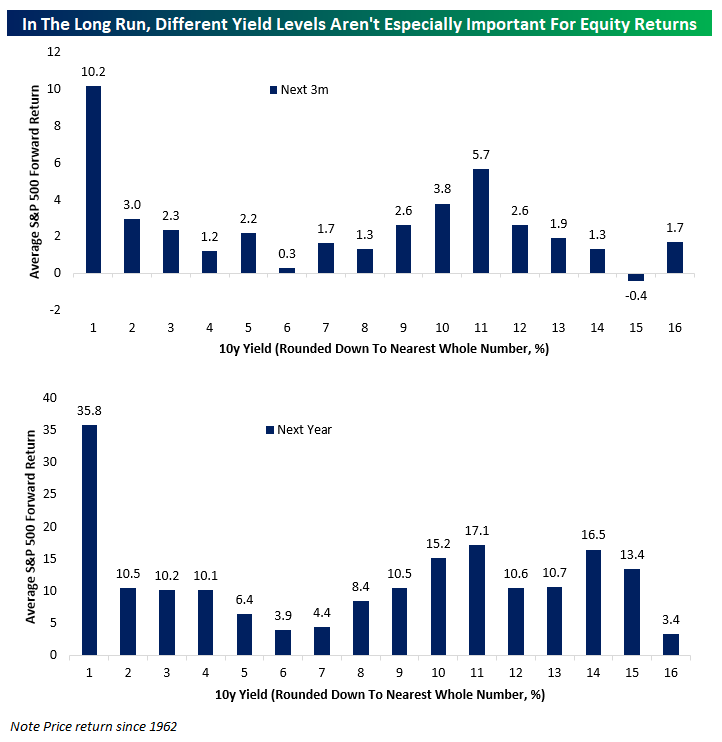
This week we look at the historical relationship between rising bond yields and stock market returns. The 10-year U.S. Treasury yield has been near and now above the 5% level, which can make investors nervous because higher bond yields can compete with stocks for yield and increase borrowing costs for companies and consumers. However, history suggests the level of yields alone does not automatically determine where equities go next.
Since 1962, the S&P 500 returns have varied across different 10-year Treasury yield levels, but the relationship has not been as simple as “higher yields mean lower stocks.” Mid-single-digit yields have generally been a bit less favourable than very low yield environments, but average forward returns were still positive. In other words, a 5% yield can be a headwind, but it has not historically been enough on its own to derail equity returns as the following chart highlights.
Source: Bespoke Investment Group
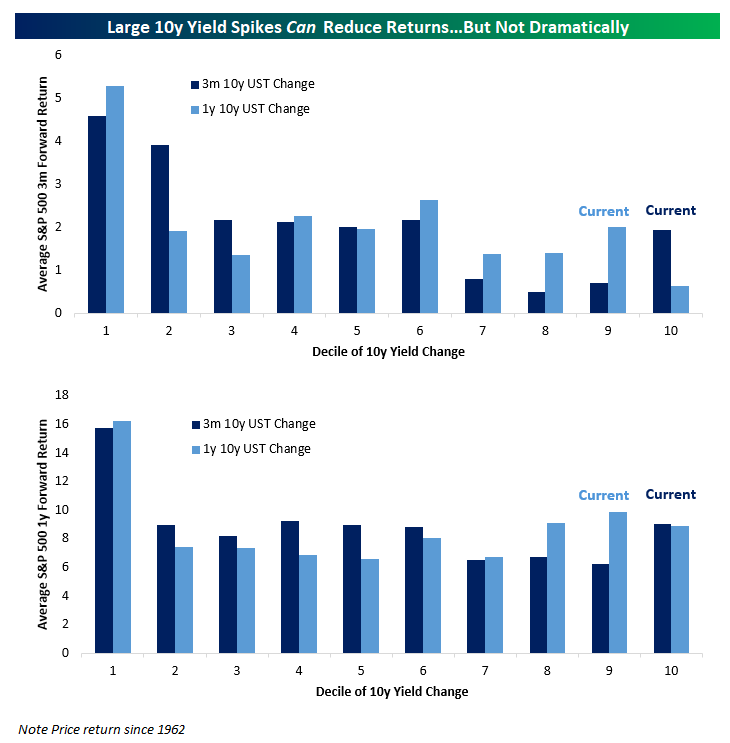
The pace of the yield move also matters. Recently, the 10-year Treasury yield has risen quickly, with the one-year change ranking in the 9th decile and the three-month change ranking in the 10th decile historically. Sharp increases in yields can create short-term pressure for stocks, and historically, forward three-month returns have been more muted after these types of moves. Looking one year out, though, returns have generally been closer to normal – see bottom half of the next chart, suggesting that fast-rising yields are not always a long-term negative for equities.
Source: Bespoke Investment Group
The key question is why yields are rising. If yields are rising because investors are worried about inflation, deficits, or a loss of confidence in the bond market, that can be more concerning. But if yields are rising because the economy is stronger than expected, the impact can be less negative for stocks. Stronger growth can support corporate earnings, which may help offset some of the pressure from higher interest rates.
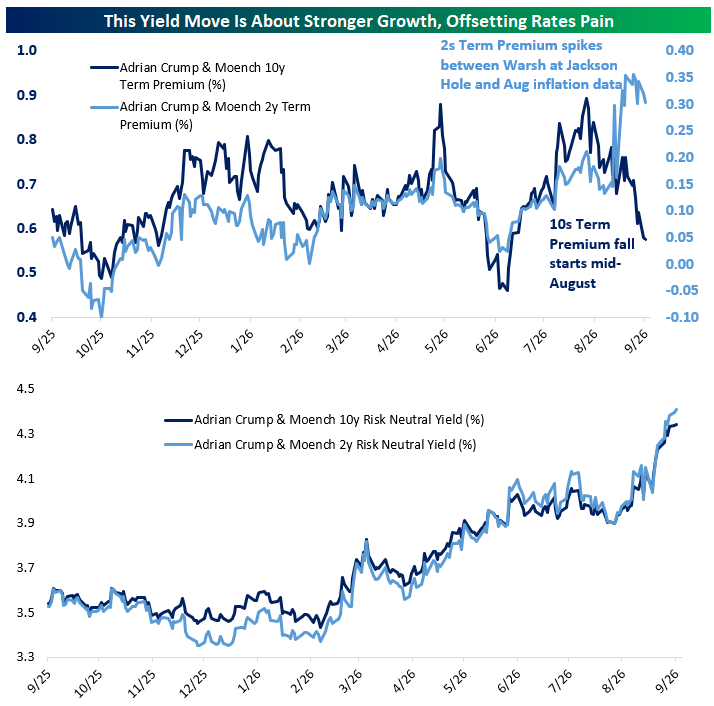
That appears to be the case in the current environment. Bespoke Investment Group’s analysis on the next chart suggests the recent move in yields has been driven more by stronger growth expectations than by a sharp rise in longer-term inflation fear. That distinction matters. One way to tell is by something called the “term premium”, which is the extra return investors demand for the risk of tying up money in a long-term bond when the future is uncertain. If investors were worried about runaway deficits or the Fed losing its grip in inflation, you would expect the long-term premium to jump. That isn’t what we’re seeing. While short-term premiums rose in September due to the pricing in the Fed’s rate hike, long-term premiums have actually fallen since mid-August. In other words, yields are rising because the economy is running hotter than expected and the long-term outlook is improving, not because investors are overly nervous. Higher rates caused by a healthier economy are quite different from higher rates caused by inflation or credit stress.
Source: Bespoke Investment Group
For investors, the takeaway is that rising yields deserve attention, but they should not be viewed in isolation. A 5%+ 10-year Treasury yield can create competition for stocks and may limit near-term upside, but history does not suggest it is automatically bad for equity markets. The reason behind the move matters most. If yields are rising because the economy remains resilient, stocks can still perform reasonably well, especially if earnings growth continues to hold up.
Sources: Bloomberg, Yahoo Finance, Global News, CBC, First Trust, Bespoke Investment Group
©2026 Milestone Wealth Management Ltd. All rights reserved.
DISCLAIMER: Investing in equities is not guaranteed, values change frequently, and past results are not necessarily an indicator of future performance. Investors cannot invest directly in an index. Index returns do not reflect any fees, expenses, or sales charges. Opinions and estimates are written as of the date of this report and may change without notice. Any commentaries, reports or other content are provided for your information only and are not considered investment advice. Readers should not act on this information without first consulting Milestone, their investment advisor, tax advisor, financial planner, or lawyer. This communication is intended for Canadian residents only and does not constitute as an offer or solicitation by anyone in any jurisdiction in which such an offer is not allowed.