Market Insights: Senate Control Hinges on a Handful of Key Races
Milestone Wealth Management Ltd. - Oct 23, 2026
Steve Nielsen, B.Comm, CFP®, CIM®, Chief Investment Officer. Week ending October 23, 2026.
Three Things to Know
Canadian Inflation
Headline CPI hit 3.1% on surging energy costs, but the Bank of Canada’s core measures eased to 1.9% and 1.8%.
U.S. Labour Market
Jobless claims fell to 194,000, near the lowest since 1969, yet employers added just 29,000 jobs in September.
Senate Control
Prediction markets give Democrats roughly a 64% chance of winning the Senate, with Maine, Ohio, Texas and Alaska likely decisive.
The Week at a Glance
S&P/TSX Composite
-1.07%
on the week
S&P 500
-0.47%
on the week
Dow Jones Industrial
+0.41%
on the week
Canadian Dollar
71.35¢
vs. 70.68¢ USD
WTI Crude
$103.51
vs. US$98.99
Gold
$4,010
vs. US$4,188
Recent Insights
Macroeconomic & Market Developments
- Canada’s annual inflation rate increased to 3.1% in September from 3.0% in August, slightly below expectations of 3.2%, as higher energy costs pushed inflation above the Bank of Canada’s 1%–3% target range. Energy prices surged 19.0% year-over-year, including a 27.8% increase in gasoline prices, accounting for much of the headline inflation pressure. However, underlying inflation showed signs of moderation, with CPI excluding gasoline slowing to 2.2% from 2.4%, while the Bank of Canada’s preferred core measures, CPI-median and CPI-trim, eased to 1.9% and 1.8%, respectively. Grocery prices also rose at their slowest annual pace since May 2024.
- Canada’s Parliamentary Budget Office (PBO) lowered its 2026 real GDP growth forecast to 0.9% from 1.1%, while reducing its 2027 outlook to 1.5% from 1.6%, citing escalating U.S. tariffs and continued trade uncertainty. The PBO estimates that if current trade restrictions remain in place, they could reduce Canada’s real GDP by approximately 1.4% over the medium term compared with a scenario without the measures. Meanwhile, the federal deficit is projected to reach $63.3 billion in 2026–27 and peak at $70.2 billion in 2027–28, remaining above $63 billion annually through 2030–31. Despite stronger nominal tax revenues from higher commodity prices, additional federal spending is expected to keep deficits elevated, with federal debt projected to rise from 40.8% to 42.6% of GDP by 2030–31. The outlook highlights growing fiscal pressures alongside weak economic growth.
- U.S. initial jobless claims fell by 6,000 to 194,000 for the week ending October 17, approaching their lowest levels since 1969, as layoffs remained historically low despite ongoing economic uncertainty. Claims have now remained at or below 200,000 for six consecutive weeks, while the four-week moving average declined to 197,750, its lowest reading in 57 years. However, hiring remains relatively subdued, with employers adding just 29,000 jobs in September, compared with 133,000 in August, reflecting a labour market characterized by limited hiring and limited layoffs. Continuing unemployment claims also increased by 25,000 to 1.728 million. With unemployment at 4.2%, the labour market continues to show resilience.
- Ontario is preparing to import 600 megawatts of electricity from the United States this winter, just months after Premier Doug Ford threatened to cut off power exports to American states amid ongoing trade tensions. The province’s Independent Electricity System Operator (IESO) signed a six-month agreement with New York-based Alpha Generation, beginning November 1, to support electricity supplies during scheduled maintenance and periods of peak winter demand. While Ontario remains a net exporter of electricity, the arrangement presents an awkward contrast to Ford’s earlier threats to use electricity as leverage in the Canada-U.S. trade dispute. The deal was negotiated independently of the provincial government as part of normal grid planning, but the timing highlights a rather inconvenient reality: the same cross-border energy relationship Ontario threatened to disrupt is now helping the province secure its own winter electricity supply.
- Meta Platforms has been ordered to pay $25 billion after a New Mexico jury found the company misled Facebook users about its data privacy practices, marking one of the largest financial penalties imposed against a technology company by a single U.S. state. The case stems from the Cambridge Analytica scandal, in which personal information from up to 87 million Facebook users was obtained without their consent. Jurors determined that Meta made 26 misleading statements and committed nearly 44 million violations of New Mexico’s consumer protection laws. Although the court initially calculated potential penalties exceeding $219 billion, the judge reduced the award to $25 billion. Meta plans to appeal the ruling, meaning the final financial liability remains uncertain. The decision highlights the substantial regulatory and legal risks facing major technology companies over consumer privacy and data protection.
Weekly Diversion
Charts of the Week
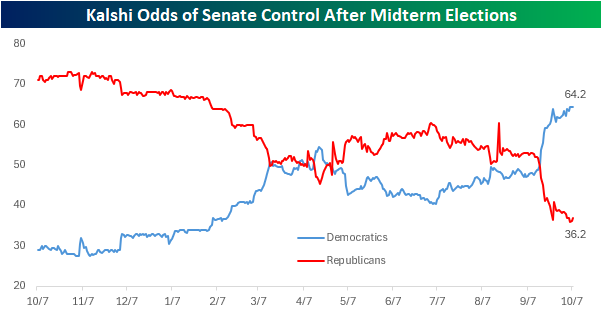
With U.S. midterm elections approaching, the battle for control of the Senate has become increasingly competitive. According to Bespoke Investment Group's research as of October 7th, prediction markets have shifted considerably in recent months, with Democrats moving from underdogs to favourites to take control. These markets allow participants to place trades based on expected election outcomes, providing a snapshot of how investors and traders assess the likelihood of different results.
Source: Bespoke Investment Group
The shift in expectations has been significant. A year earlier, Republicans were given more than a 70% chance of retaining Senate control, and as recently as July, those odds remained above 60%. However, as oil prices and interest rates climbed toward the end of summer, Republican odds began to decline. By early October, Kalshi's prediction market placed the probability of Democrats taking control at approximately 64%, compared with roughly 36% for Republicans.
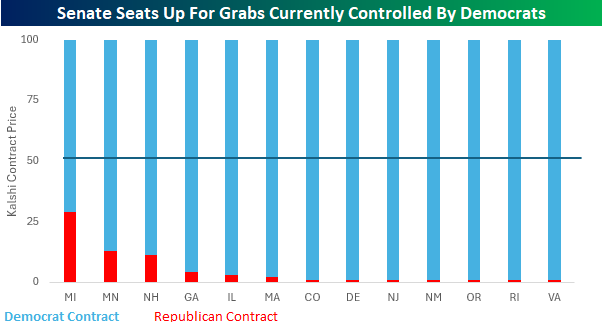
A closer look at the individual races helps explain the changing outlook. Of the 35 Senate seats up for election, Democrats currently hold 13, while Republicans hold 22. According to the October 7th prediction market data, Democrats were favoured to retain all 13 of their seats. In fact, 10 of those races had Democratic contract prices of 95 or higher out of 100, suggesting that most were considered relatively safe. Michigan appeared to be the most competitive Democratic-held seat, with the Democratic candidate favoured at approximately 71%.
Source: Bespoke Investment Group
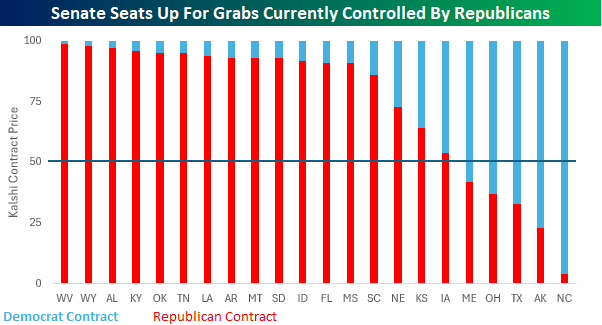
The Republican side presents a more challenging picture. While the party was favoured to retain 17 of its 22 seats, five races showed Democratic candidates leading in prediction markets. North Carolina stood out as the most likely to change hands, with Democrats given approximately a 96% chance of winning. That leaves Maine, Ohio, Texas, and Alaska as potentially decisive contests. With Republicans holding a 53–47 Senate majority, they can afford to lose a net three seats and still retain control through the Vice President's tie-breaking vote.
Source: Bespoke Investment Group
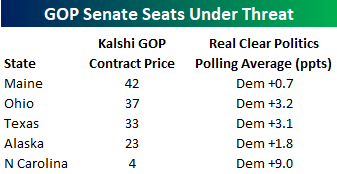
Although prediction markets currently favour Democrats in these competitive races, polling suggested that several contests could be closer than the betting odds imply. In Ohio and Texas, Democratic candidates held polling leads of just over three percentage points, while the lead in Alaska was less than two points. Maine also remained competitive, with Democrats ahead by less than one percentage point. These relatively narrow margins suggest that even modest changes in voter support could significantly influence the final outcome.
Source: Bespoke Investment Group
What This Means for Investors
For investors, the takeaway is that the Senate's political balance remains uncertain despite the shift in prediction market expectations. While Democrats held the advantage in the early October data, several competitive races could still determine the outcome. The difference between polling results and prediction market odds also highlights how quickly expectations can change as Election Day approaches. With control potentially resting on a handful of states, the final result remains far from guaranteed.
Sources: Bloomberg, Yahoo Finance, Fox Business, CBC, Reuters, Money.ca, Bespoke Investment Group.
Milestone Recession Risk™ Composite

As of October 16, 2026
What it is: A rules-based dashboard we use to watch for recessions and decide when to take risk off the table.
Why it matters to you: No one can predict every market dip, and we don’t try to. The Composite gives us a disciplined way to respond when the evidence points to rising recession risk, so decisions rest on data rather than headlines.
DISCLAIMER: Investing in equities is not guaranteed, values change frequently, and past results are not necessarily an indicator of future performance. Investors cannot invest directly in an index. Index returns do not reflect any fees, expenses, or sales charges. Opinions and estimates are written as of the date of this report and may change without notice. Any commentaries, reports or other content are provided for your information only and are not considered investment advice. Readers should not act on this information without first consulting Milestone, their investment advisor, tax advisor, financial planner, or lawyer. This communication is intended for Canadian residents only and does not constitute as an offer or solicitation by anyone in any jurisdiction in which such an offer is not allowed.